

Endometriosis-Related Fibroids: Surgery or Medication?
Endometriosis often leads to uterine fibroids, causing symptoms such as painful menstruation and heavy menstrual bleeding. Whether surgery is necessary should not be determined solely by the size of the fibroid; a comprehensive evaluation of symptoms, fertility needs, and disease progression is essential.
Surgery is generally recommended when a fibroid exceeds 5 cm in diameter, but for smaller fibroids (below 5 cm), the treatment plan should be individualized based on specific clinical conditions. Medication therapy is a common and effective management option for such cases.
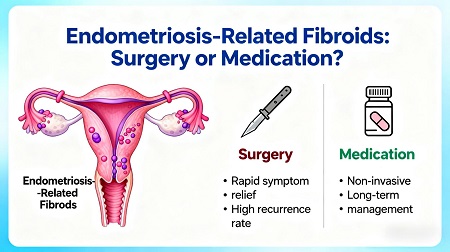
I. When Should You Have Surgery for Fibroids Caused by Endometriosis?
1. When Surgery Is Recommended (Including Fibroids Over 5 cm or Special Cases)
Fibroids 5 cm or larger with obvious symptoms:
If your uterine fibroids cause strong period pain that painkillers can't relieve, heavy bleeding leading to anemia, long periods, or pressure on your bladder (frequent urination) or rectum (constipation) that affects your daily life or work — surgery is often advised.
Fibroids smaller than 5 cm but growing quickly:
If the fibroid grows more than 2 cm in a year or doubles in 3–6 months, even though cancer risk is low, surgery helps confirm the cause and prevent complications.
When it affects fertility:
If it's confirmed that fibroids (especially those inside the uterus) or endometriosis lesions block embryo implantation or affect early pregnancy, surgery may improve your chances of conceiving.
Severe endometriosis:
When there are extensive pelvic adhesions or ovarian “chocolate cysts” larger than 4 cm, and medicine isn't working, doctors often suggest laparoscopic surgery to treat both at once.
Emergency situations:
If a fibroid twists (causing sudden abdominal pain) or ruptures and bleeds, immediate surgery is needed.
2. When You Can Wait and Avoid Surgery (Usually for Fibroids Under 5 cm)
Small, symptom-free fibroids:
If you only found out during a check-up, your periods are normal, and you have no discomfort or pregnancy plans, you can simply monitor it with an ultrasound every 6–12 months and maintain healthy habits.
Near menopause:
As estrogen naturally drops, fibroids may shrink on their own. If symptoms are mild, conservative care (no surgery) is preferred.
Planning to have children:
If fibroids are small and symptoms are light, medication can be used first. After pregnancy, the situation can be reassessed.
II. Medication Therapy for Fibroids Under 5 cm: Choose Based on Symptoms and Condition
The goals of treatment are to relieve symptoms, control fibroid growth, and suppress endometriotic lesions.
Note: All medications should be taken under medical supervision — do not self-medicate.
1. Nonsteroidal Anti-inflammatory Drugs (NSAIDs): Pain Relief
Indications:
For mild to moderate menstrual or pelvic pain associated with endometriosis.
These drugs do not shrink fibroids, but help manage discomfort.
Common options:
Ibuprofen, naproxen, diclofenac sodium (available over the counter).
Dosage:
Take 1–2 tablets, three times a day as directed in the leaflet, preferably after meals to reduce stomach irritation.
Avoid continuous use for more than 7 days. If pain recurs frequently, treatment should be adjusted.
Cautions:
Use with care in patients with gastric ulcers or kidney problems.
Regularly monitor liver and kidney function during long-term use.
2. Hormonal Therapy: The Core of Disease Control
Hormonal therapy works by regulating estrogen levels to relieve symptoms and suppress fibroid and endometriosis growth.
It must be used strictly under a doctor's guidance.
Combined Oral Contraceptives (COCs):
Indications:
For mild to moderate endometriosis with small fibroids, especially in women with irregular or heavy periods, mild menstrual pain, and no pregnancy plans.
Mechanism:
Low-dose estrogen–progestin combinations stabilize hormone levels, reduce endometrial shedding, and suppress lesion and fibroid growth.
Common medications:
Drospirenone-ethinylestradiol, desogestrel-ethinylestradiol.
Dosage:
Start within the first 1–5 days of menstruation. Take one tablet daily for 21 days, followed by a 7-day break.
Avoid missed doses to prevent breakthrough bleeding.
Cautions:
Contraindicated in women with blood clots, breast cancer, hypertension, or diabetes.
A pregnancy test should be done before starting.
Regularly monitor breast ultrasound and liver/kidney function.
Stop 3–6 months before trying to conceive.
Progestin Therapy
Indications:
For moderate endometriosis with fibroids, especially with severe pain, heavy bleeding, or as preoperative therapy to shrink lesions.
Mechanism:
Progestins oppose estrogen effects, causing the endometrial and ectopic tissue to shrink and slowing fibroid growth.
Common medications:
Dydrogesterone, medroxyprogesterone acetate.
Dosage:
Dydrogesterone: 10–20 mg once or twice daily, from day 11 of the cycle for 10–14 days.
Medroxyprogesterone acetate: 5–10 mg once daily for 21 days per cycle.
Cautions:
Long-term use may cause mild weight gain, breast tenderness, or mood swings (usually reversible after stopping).
Regularly monitor endometrial thickness; adjust the regimen if thickening occurs.
Gonadotropin-Releasing Hormone (GnRH) Agonists:
Indications:
For moderate to severe endometriosis with fibroids, when other medications are ineffective or pre-surgical reduction is needed.
Mechanism:
Suppresses gonadotropin secretion, reduces estrogen levels, and causes regression of lesions and fibroids.
Common medications:
Leuprorelin acetate, goserelin acetate (injection).
Dosage:
Leuprorelin acetate 3.75 mg every 4 weeks, for 3–6 months;
Goserelin acetate 3.6 mg every 4 weeks, same duration.
Cautions:
Possible temporary side effects include amenorrhea, hot flashes, and night sweats (reversible after discontinuation).
Long-term use may reduce bone density — calcium and vitamin D supplements are recommended.
Use with caution in patients with osteoporosis or impaired liver/kidney function.
Regularly monitor ultrasound, bone density, and organ function.
3. Traditional Chinese Medicine (TCM): Personalized Syndrome-Based Approach
From a TCM perspective, this condition is mainly due to Qi stagnation and blood stasis.
Treatment focuses on promoting blood circulation, regulating Qi, and dissolving masses, with individualized prescriptions from a qualified TCM gynecologist.
Core Herbal Categories
Activate blood circulation: Angelica sinensis, Ligusticum chuanxiong, Paeonia rubra — suitable for fixed menstrual pain and clotted blood flow.
Regulate Qi: Cyperus rotundus, Curcuma aromatica — for emotionally related menstrual pain.
Dissolve masses: Sparganium stoloniferum, Curcuma zedoaria — for firmer fibroids.
Tonify Qi: Astragalus membranaceus, Codonopsis pilosula — for anemia and fatigue.
Practical Recommendations:
Consult a certified TCM gynecologist for a personalized formula (e.g., Xue Fu Zhu Yu Tang) or standardized Chinese patent medicine such as Fuyan Pill.
Functions of Fuyan Pill:
Promotes pelvic blood circulation and relieves menstrual pain with clots;
Helps stabilize or shrink fibroids under 5 cm;
Clears heat and detoxifies, improving mild pelvic inflammation and abnormal discharge associated with endometriosis.
Cautions:
TCM works gradually and should be combined with healthy lifestyle adjustments.
Avoid cold, spicy, and greasy foods.
Have regular ultrasound check-ups.
If lesions enlarge, integrate Western medical treatment as appropriate.
III. Treatment Precautions
1. Regular Follow-Up Examinations
Frequency:
During medication therapy, review every 3–6 months, including:
Gynecological ultrasound: to monitor fibroid size, endometrial thickness, and endometriotic lesions.
Complete blood count: to check for anemia.
Liver and kidney function tests: to detect possible drug-related side effects.
Key points:
If a fibroid grows ≥1 cm within six months or symptoms worsen, treatment should be adjusted — and surgery considered if necessary.
After menopause, schedule annual ultrasounds to monitor any changes in fibroid size.
2. Lifestyle Adjustments
Diet:
Maintain balanced nutrition.
Eat foods rich in protein, vitamins, and iron (such as lean meat and spinach) to prevent anemia.
Limit foods high in phytoestrogens or hormonal activity (such as royal jelly or snow frog), and consume soy products in moderation.
Exercise:
Engage in regular physical activity such as brisk walking or yoga, 30 minutes per session, 3–5 times per week.
Exercise improves circulation, eases menstrual cramps, and helps maintain a healthy weight — excess fat can raise estrogen levels and promote fibroid growth.
Emotional Health:
Avoid prolonged stress, anxiety, or depression, which can lead to “Qi stagnation and blood stasis” (in TCM terms).
Relax through music, meditation, or breathing exercises.
Sleep:
Get at least 7 hours of sleep per night and avoid staying up late.
Regular sleep helps stabilize hormones and support recovery.
Conclusion: Individualized Treatment Planning
Fibroids (≥5 cm) with obvious symptoms, rapid growth, or fertility issues: Laparoscopic surgery is generally the preferred option.
Fibroids (<5 cm) with mild symptoms and no immediate fertility plans: Medication therapy is recommended — NSAIDs for pain relief, hormonal therapy to control disease progression, and Fuyan Pill as a supportive treatment — plus regular follow-up.
Regardless of the treatment path, all therapy should be guided by a qualified gynecologist. Avoid self-medicating or delaying treatment. Combine medical therapy with healthy lifestyle habits to control disease progression and improve quality of life.
Can Chinese Herbs Eliminate Endometriotic Lesions? — Evaluating the Role of Blood-Invigorating and Mass-Resolving Therapy in Endometriosis
previous pageTCM Treatment of Endometriosis: Herbal Formulas for Qi Stagnation and Cold Blood Stasis
next page- Managing Endometriosis-Related Chronic Pelvic Pain with TCM
- TCM Treatment of Endometriosis: Herbal Formulas for Qi Stagnation and Cold Blood Stasis
- Endometriosis-Related Fibroids: Surgery or Medication?
- Can Chinese Herbs Eliminate Endometriotic Lesions? — Evaluating the Role of Blood-Invigorating and Mass-Resolving Therapy in Endometriosis
- High Recurrence Rate after Surgery for Endometriosis: Long-term Drug Management and Consolidation Plan of Herbal Medicine
Testimonials
- Adenomyosis with Ureaplasma Urealyticum Cured by Fuyan Pill
- Tubal blockage with hydrosalpinx can be cured by TCM shortly
- Fuyan Pill Helps A woman with Adenomyosis Get Pregnant
- A Woman with Hydrosalpinx Is Cured with Fuyan pill
- Pelvic Inflammatory Disease Testimonials
- Irregular Vaginal Bleeding and Endometrial Thickening Cured by Fuyan Pill
- Pruritus Vulvae and Frequent Urination: Mycoplasma Infection Cured after 2 Courses