

Managing Endometriosis-Related Chronic Pelvic Pain with TCM
“Pain so severe during menstruation that cold sweat breaks out, a constant heavy sinking feeling in the pelvis,” “pain with intercourse, even affecting daily activities” — if you are troubled by this kind of pain, it is very likely caused by chronic pelvic pain due to endometriosis.
The core problem of endometriosis is that endometrial tissue, which should normally stay inside the uterus, “migrates” and implants outside the uterus. These ectopic tissues bleed cyclically in response to hormonal changes, irritating pelvic tissues and causing inflammation and adhesions, which in turn lead to pelvic pain lasting more than six months. Besides severe menstrual pain, persistent heaviness in the lower abdomen, lumbosacral soreness, and pain during intercourse often accompany the condition.
Epidemiological data show that the prevalence of endometriosis among women of reproductive age is about 10%, with the highest incidence occurring between the ages of 25 and 35. About 85% of patients experience an impact on their work and daily life, 19% are unable to work due to pain, and 69% endure the pain in silence. But there is hope — Traditional Chinese Medicine offers a range of gentle and effective approaches to help manage this stubborn pain.
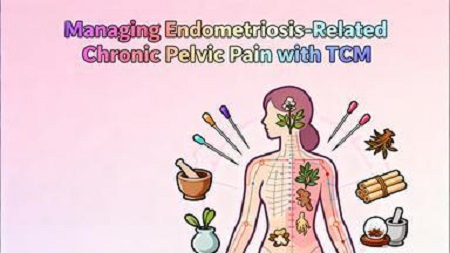
How Does Traditional Chinese Medicine (TCM) View Chronic Pelvic Pain Caused by Endometriosis?
Western medicine usually explains the pelvic pain in terms of inflammation and adhesions, while TCM points directly to the core cause — “blood stasis.” Ectopic endometrial tissue bleeds but cannot be properly discharged, leading to stagnant blood in the pelvic cavity. This blocks the flow of qi and blood, and, as the saying goes in TCM, “where there is obstruction, there is pain.”
However, the causes of blood stasis are not all the same. Exposure to cold or consuming cold foods and drinks can lead to “cold-induced blood stasis,” often accompanied by a cold sensation in the lower abdomen. High stress and frequent anger can result in “qi stagnation and blood stasis,” with stabbing pain and chest tightness. Postpartum weakness or heavy menstrual bleeding may cause “qi deficiency with blood stasis,” in which pain is accompanied by fatigue and a pale complexion.
Therefore, TCM treatment is never one-size-fits-all. It is based on pattern differentiation, combining tongue and pulse examination with symptom assessment to determine cold or heat, deficiency or excess, before formulating a personalized treatment plan.
TCM Treatments for Chronic Pelvic Pain
Oral herbal medicine:
Internal herbal therapy is the core of TCM treatment, acting like a customized “circulation regulator” for qi and blood. Doctors prescribe formulas based on individual patterns: for cold-induced blood stasis, herbs such as Cinnamon Twig and Mugwort Leaf are used to warm the meridians and dispel cold; for qi stagnation with blood stasis, Bupleurum and Cyperus are added to soothe the liver and regulate qi; for qi deficiency with blood stasis, Astragalus and Codonopsis are used to tonify qi and promote blood circulation.
If decocting herbal formulas feels cumbersome, the clinically validated Fuyan Pill is an excellent alternative. It follows the principles of activating blood circulation and removing stasis, clearing heat and detoxifying, and strengthening the spleen and draining dampness, directly addressing the core “blood stasis” mechanism of endometriosis while also supporting pelvic inflammation management.
Its ingredients target specific effects: Chinese Angelica Root and Safflower promote blood circulation and resolve stasis, improving pelvic blood flow; Honeysuckle flower and Forsythia fruit clear heat and detoxify, reducing inflammation caused by ectopic endometrial tissue; Atractylodes macrocephala and Poria cocos strengthen the spleen and remove dampness, accelerating the elimination of metabolic waste. Like decoctions, Fuyan Pill developed by Dr.Lee's clinic regulates the liver, spleen, and kidney from the root. Once qi and blood flow smoothly and stasis dissipates, pain naturally eases.
Many patients who lack time to prepare decoctions report that, with consistent use, not only is menstrual pain and pelvic heaviness relieved, but abnormal vaginal discharge also improves noticeably. It is important to note that whether using decoctions or Fuyan Pill, treatment should always be guided by a doctor to ensure proper pattern differentiation and effectiveness.
Acupuncture:
Don't be afraid of acupuncture. Modern filiform needles are extremely thin, and after insertion you may only feel a mild soreness or distension, which is much lighter than menstrual pain. Acupuncture relieves pain by unblocking the meridians, and doctors select acupoints precisely according to the pain location—for example, Guanyuan and Qihai for lower abdominal pain, and Shenshu and Dachangshu for lumbosacral pain.
In addition to standard filiform needles, fire needling is suitable for cold-type conditions and produces a stronger warming sensation. Abdominal acupuncture targets deeper pelvic problems by selecting points on the abdomen and is considered safer. Electroacupuncture uses mild electrical currents to enhance stimulation and help clear blocked meridians.
Moxibustion:
Most patients with endometriosis have “uterine coldness,” and moxibustion acts like a “natural heater.” The warming energy of mugwort penetrates the pelvic area, dispels cold and dampness, and promotes the smooth flow of qi and blood. Many patients report significant pain relief after moxibustion.
There are various forms of moxibustion: if you are sensitive to smoke, you can choose smokeless adhesive Baixiao moxibustion; for stronger effects, Du Meridian Moxibustion can be applied from the Dazhui (GV14) point to the Mingmen (GV4) point to warm the entire back; for severe blood stasis and intense pain, more powerful Leihuo moxibustion may be used under medical guidance.
Acupoint thread embedding:
Acupoint thread embedding is especially suitable for people who don't have time for frequent clinic visits. Absorbable threads are embedded into points such as Sanyinjiao (SP6) and Zusanli (ST36), providing continuous stimulation during dissolution—like “long-acting invisible acupuncture.”
This method can enhance metabolism and immunity, speed up pelvic qi and blood circulation, and promote the absorption of inflammation. It is usually performed once every 15–20 days, and with continued treatment, it can significantly reduce the frequency and intensity of pain, making it very friendly for working professionals.
Semiconductor Laser Therapy:
Semiconductor laser therapy is considered a “high-tech assistant” in traditional Chinese medicine. The treatment is painless, and the laser can penetrate up to 7 cm beneath the skin, accurately targeting deep pelvic endometriotic lesions.
It provides rapid pain relief, reduces deep-seated inflammation, promotes tissue repair, softens scar tissue, and inhibits bacterial growth to prevent worsening of inflammation. When combined with acupuncture and herbal medicine, the therapeutic effect can be further enhanced.
Electrical Stimulation Therapy:
Electrical stimulation therapy uses low-frequency pulses to stimulate pelvic nerves. It works by activating the body's “pain-relief nerves” to block pain signal transmission, while also promoting pelvic blood circulation, reducing blood stasis, and stimulating the release of endorphins.
During treatment, electrode pads are placed on the lower back and abdomen, and the intensity is adjusted to a comfortable level. The tingling sensation is painless, and each session lasts about 20 minutes. It is suitable both for relieving acute pain and for daily conditioning.
Conclusion
Many women become accustomed to pain and simply endure it, but chronic pelvic pain caused by endometriosis can worsen over time and may even affect fertility. The key to traditional Chinese medicine (TCM) treatment lies in accurate pattern differentiation, and it is essential to consult a professional TCM gynecologist to develop a personalized treatment plan.
During the recovery process, lifestyle adjustments are also important: avoid cold drinks and raw or chilled foods, keep the waist and lower abdomen warm, avoid prolonged sitting and get up to move around every hour to promote pelvic circulation, and maintain a relaxed and positive mood to prevent stagnation of qi and worsening blood stasis.
Although chronic pelvic pain caused by endometriosis can be persistent, with timely medical care and proper treatment, it can gradually be relieved, helping patients regain a more comfortable and relaxed life.
- Managing Endometriosis-Related Chronic Pelvic Pain with TCM
- TCM Treatment of Endometriosis: Herbal Formulas for Qi Stagnation and Cold Blood Stasis
- Endometriosis-Related Fibroids: Surgery or Medication?
- Recurrent Chronic PID: Integrated Chinese and Western Treatment for Lower Abdominal Pain and Abnormal Vaginal Discharge
- Can Chinese Herbs Eliminate Endometriotic Lesions? — Evaluating the Role of Blood-Invigorating and Mass-Resolving Therapy in Endometriosis
Testimonials
- Adenomyosis with Ureaplasma Urealyticum Cured by Fuyan Pill
- Tubal blockage with hydrosalpinx can be cured by TCM shortly
- Fuyan Pill Helps A woman with Adenomyosis Get Pregnant
- A Woman with Hydrosalpinx Is Cured with Fuyan pill
- Pelvic Inflammatory Disease Testimonials
- Irregular Vaginal Bleeding and Endometrial Thickening Cured by Fuyan Pill
- Pruritus Vulvae and Frequent Urination: Mycoplasma Infection Cured after 2 Courses